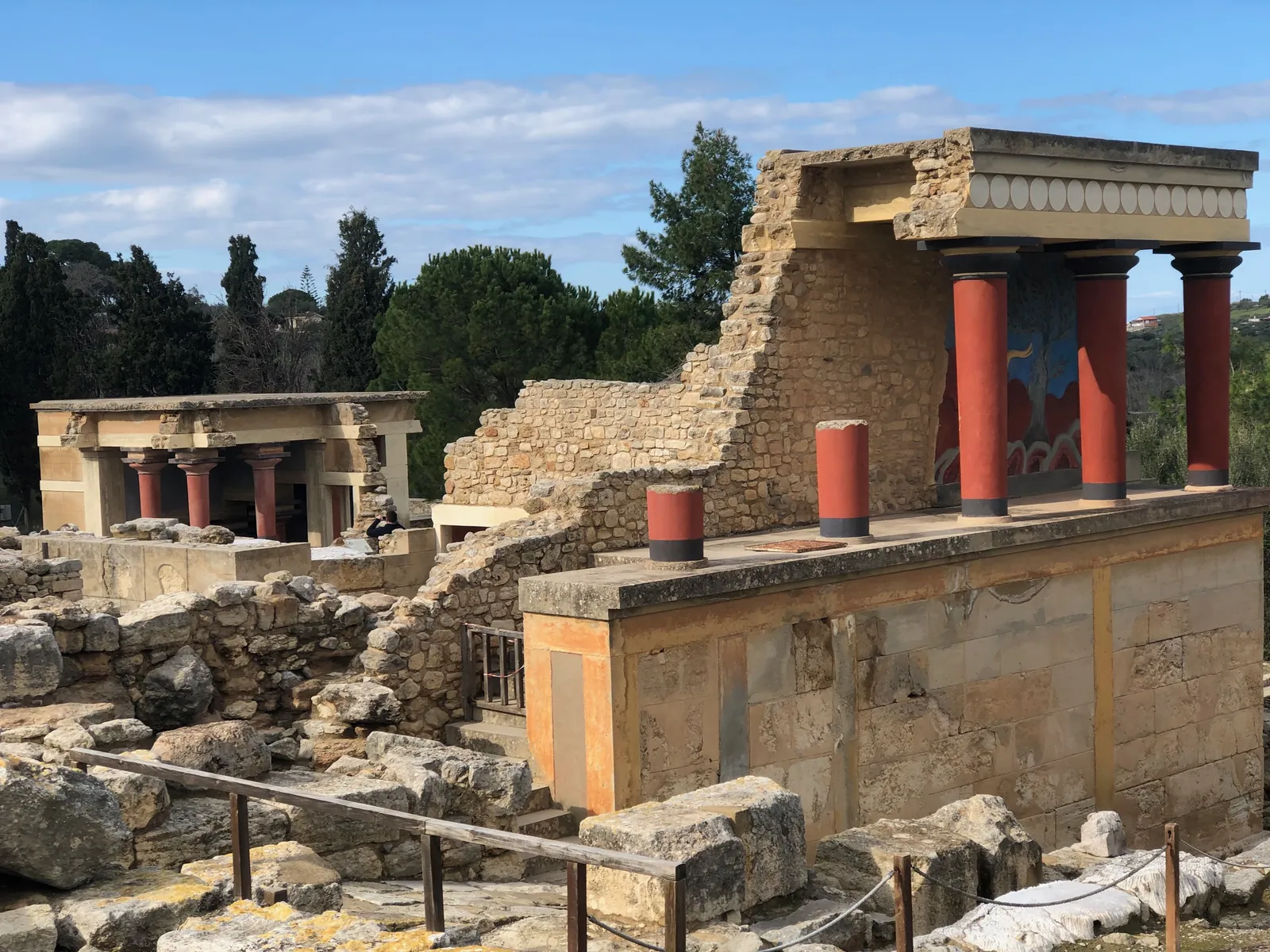
Knossos is one of the places people arrive in Crete already knowing, or believing they know. The Labyrinth, the Minotaur, red columns and painted dolphins come first.
The site itself is more complicated and more interesting: a Minoan centre shaped by excavation, interpretation and the much-argued restoration work of Arthur Evans. From a villa near Rethymno it is not a casual extra. It is a deliberate day east. The question is not whether Knossos is famous enough. It is whether your group wants to give it the time and energy the journey asks for.

By Argyris Skordilis, owner and host · Updated
Knossos was inhabited from the Neolithic period into Roman times. Its Minoan height came in the second millennium BC, when the palatial centre worked as an administrative, economic, religious and social hub all at once. The official Hellenic Heritage page describes a complex of roughly 22,000 square metres arranged around a central court, with storerooms, workshops, ceremonial areas, sanctuaries and living quarters.
In 2025 Knossos was inscribed on the UNESCO World Heritage List as one of six Minoan Palatial Centres, together with Phaistos, Malia, Zakros, Zominthos and Kydonia. It was not inscribed alone: UNESCO treats the six as one serial property that represents Minoan architecture, administration, writing, sea connections and cultural life.
Minos, the Labyrinth and the Minotaur belong to the site’s long afterlife in story. They are a good way in, especially for children. They are not a substitute for the archaeology.
Minos Kalokairinos made the first excavations on Kephala Hill in 1878. Arthur Evans led systematic excavation from 1900 to 1931 and rebuilt parts of the complex in modern materials, following his own reading of Minoan architecture.
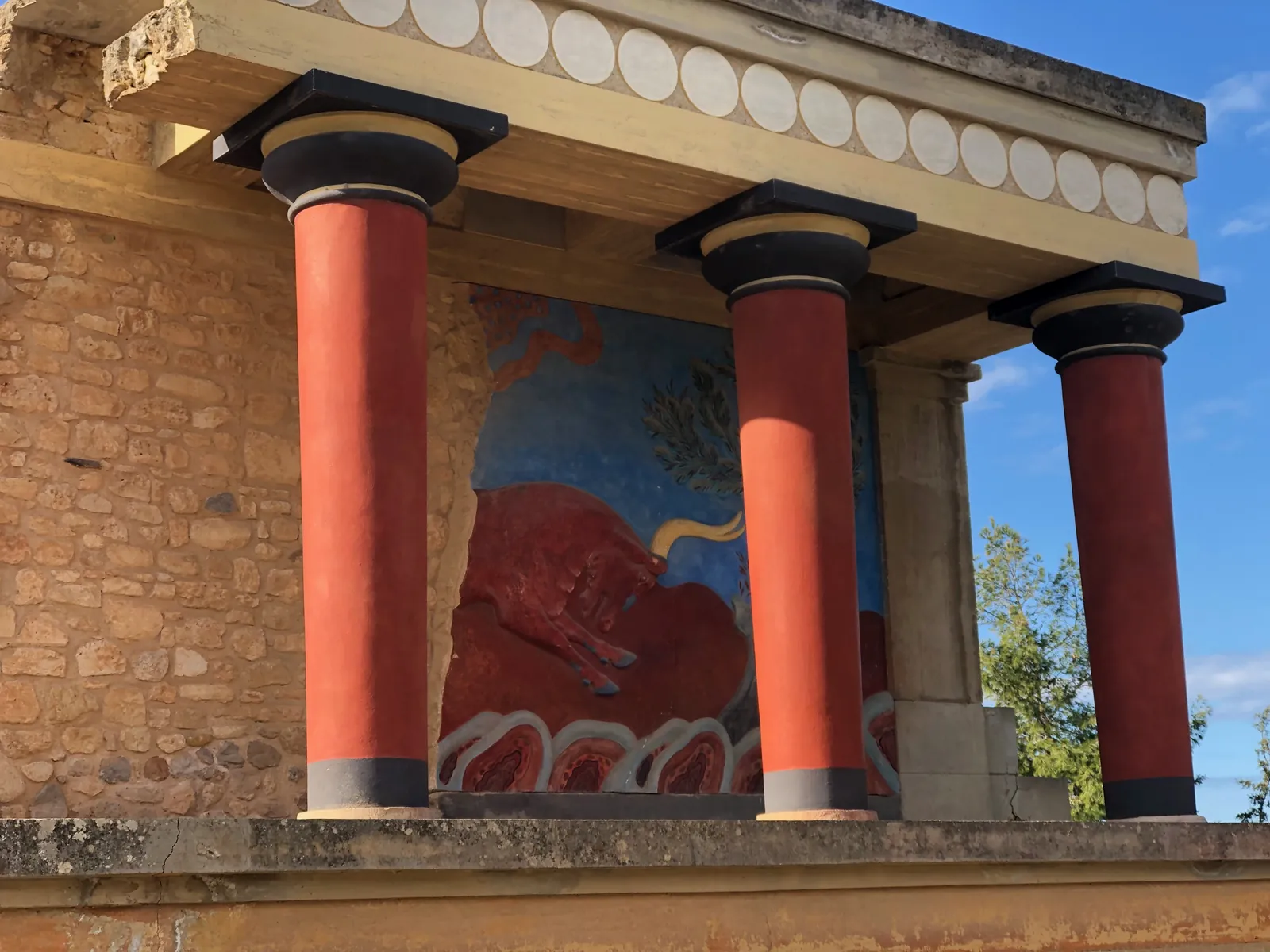
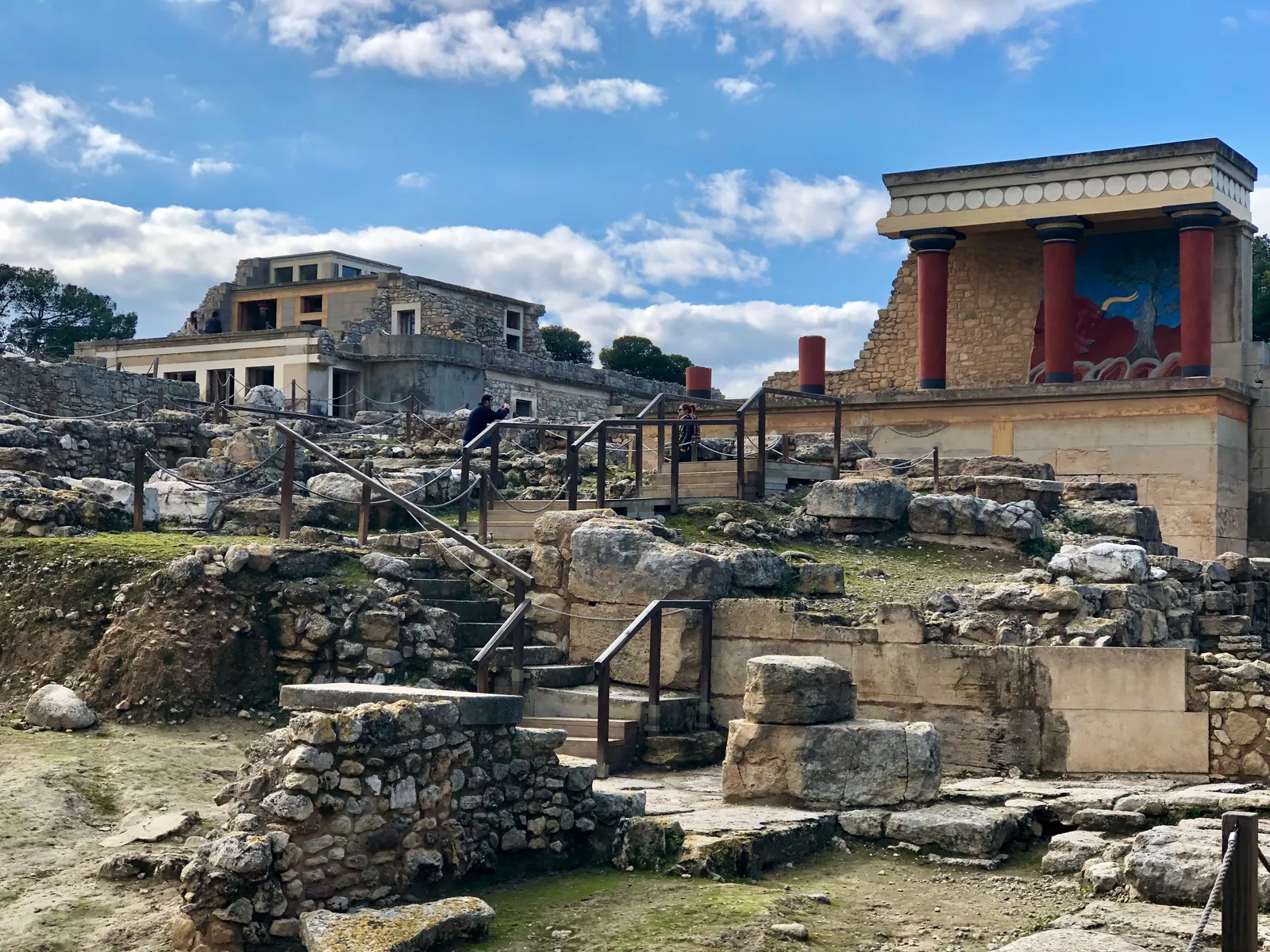
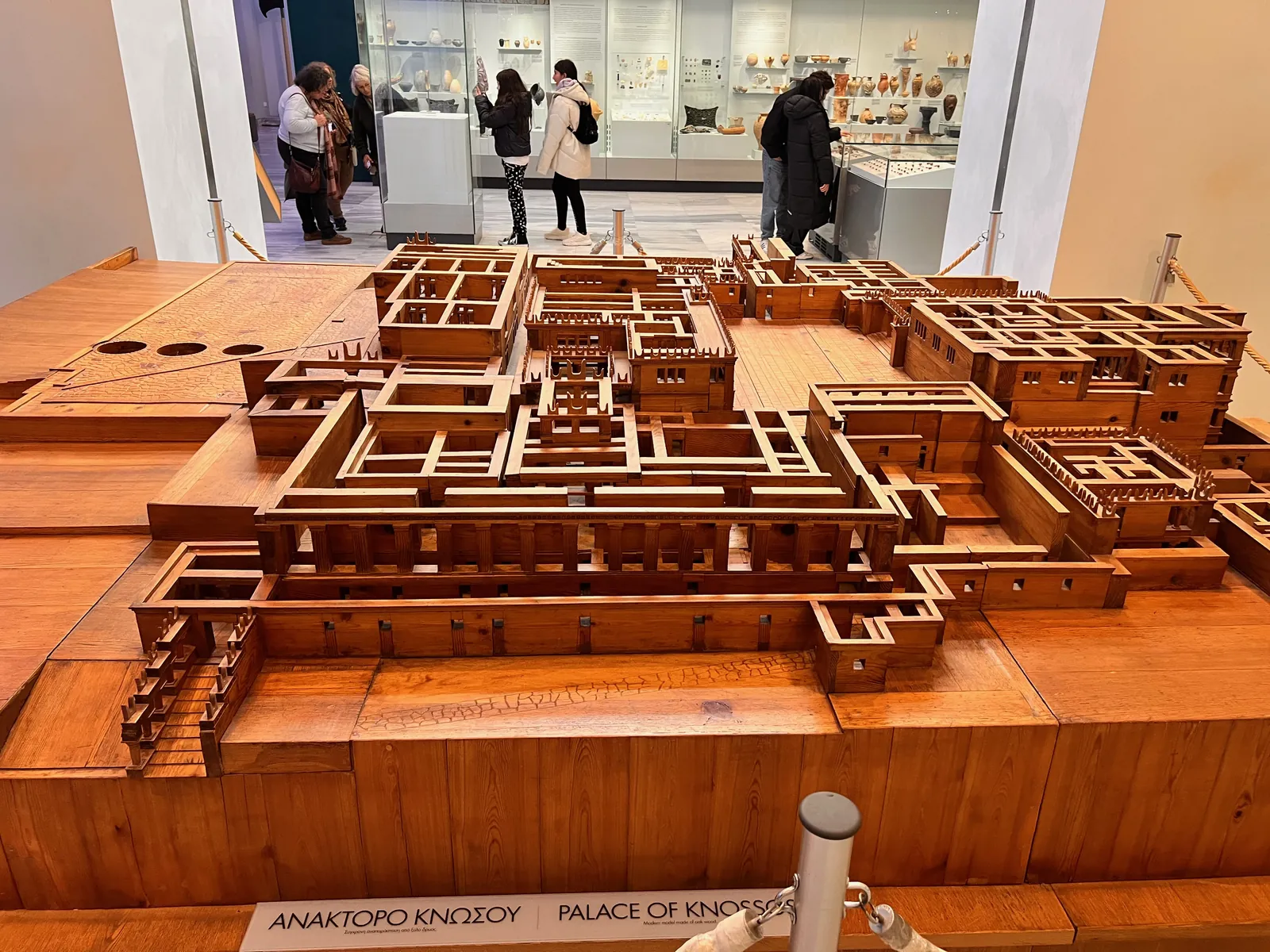
Those interventions produced many of the images people now think of as Knossos — the red columns, the restored upper floors, the painted walls in place. They are also controversial. You are not looking at untouched ruins, nor at a neutral rebuilding of how every room once was. The restorations are part of the site’s modern history, and they shape how all of us imagine the Minoan world.
That tension is what makes the visit interesting rather than a problem to be explained away. Ask, as you walk: what here is ancient, what was rebuilt, what evidence guided the rebuilding, and how has the interpretation changed since?
Allow about 1½–2 hours for the archaeological site itself. A focused highlights visit can be shorter; a guided or slower one takes longer. This is our planning estimate, not an official figure. With the drive, parking and entry on top, Knossos fills a full morning.
Buy from the official Hellenic Heritage ticket site (tickets.hh.gr). Several look-alike websites resell the same ticket at a mark-up, so check whose site you’re on before you pay. In high season, book ahead. At checkout, check the date, the admission conditions and any entry time slot, as ticket rules can change.
Reduced and free admission categories are listed on the official page; bring proof that you qualify. The same page lists the free-admission days, including the first and third Sundays from November to March, so expect more visitors then. Knossos and the Heraklion Archaeological Museum have separate tickets.
There is parking right beside the site entrance (our own local knowledge, September 2026). Availability and any charges can change, so we do not quote them. In high season, arriving close to opening makes both parking and the visit easier.
This page plans the day by car from the villas. If you want to add Archanes and a winery visit, consider a private transfer with a driver (taxi or minivan) instead of driving yourselves: nobody has to skip the wine, and nobody has to drive home after a long day. Ask Argyris and he can suggest a transfer company.
Knossos is hard to read without context, because ancient remains and modern reconstruction stand side by side.
| Option | Choose it when |
|---|---|
| Licensed guide | Archaeology is the main reason for the day. |
| Small group tour | You want the context at a lower cost. |
| Digital guide on your phone | You prefer your own pace. Hellenic Heritage publishes an official Digital Guide app; check in the app whether Knossos is currently included. |
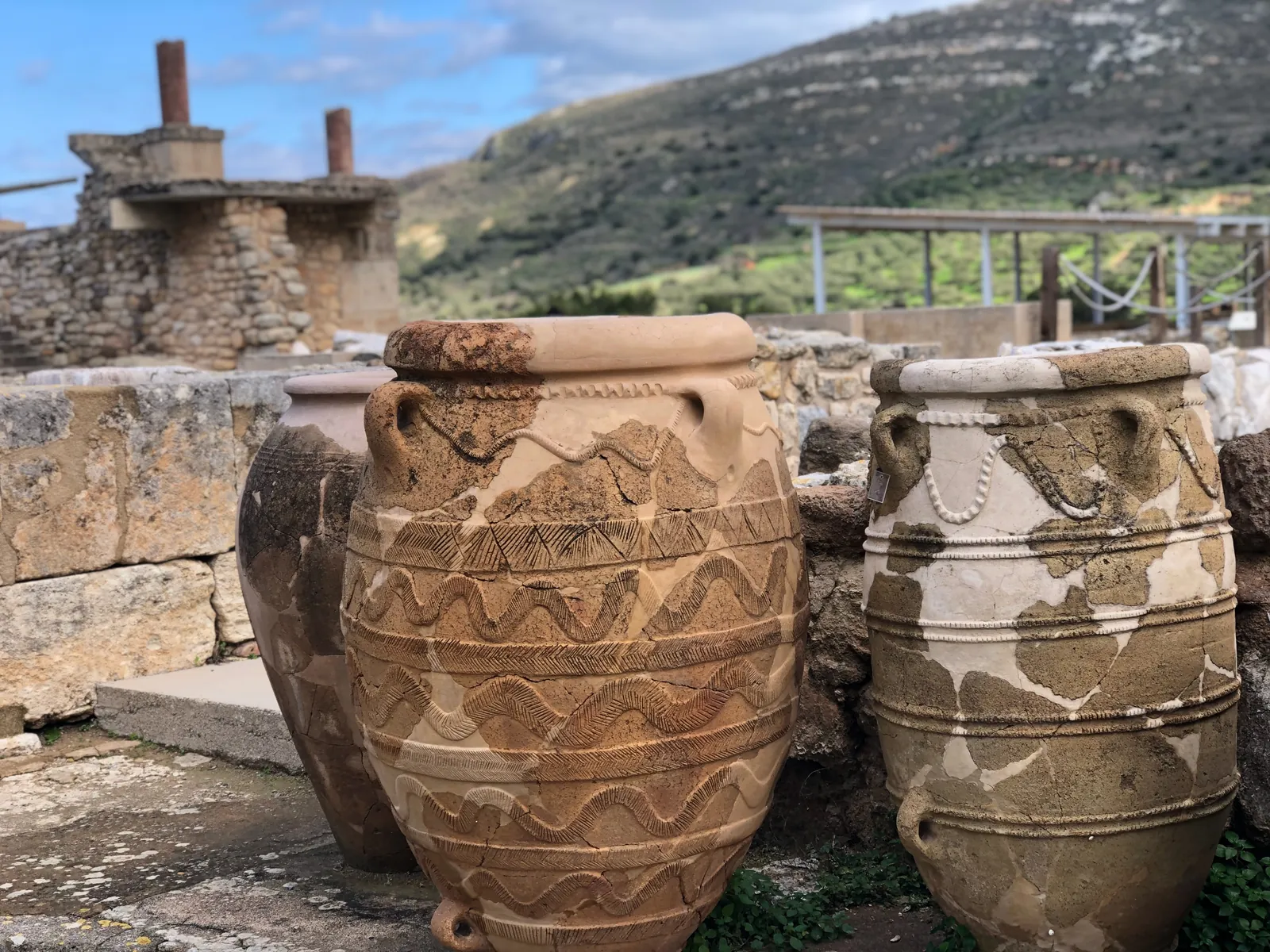
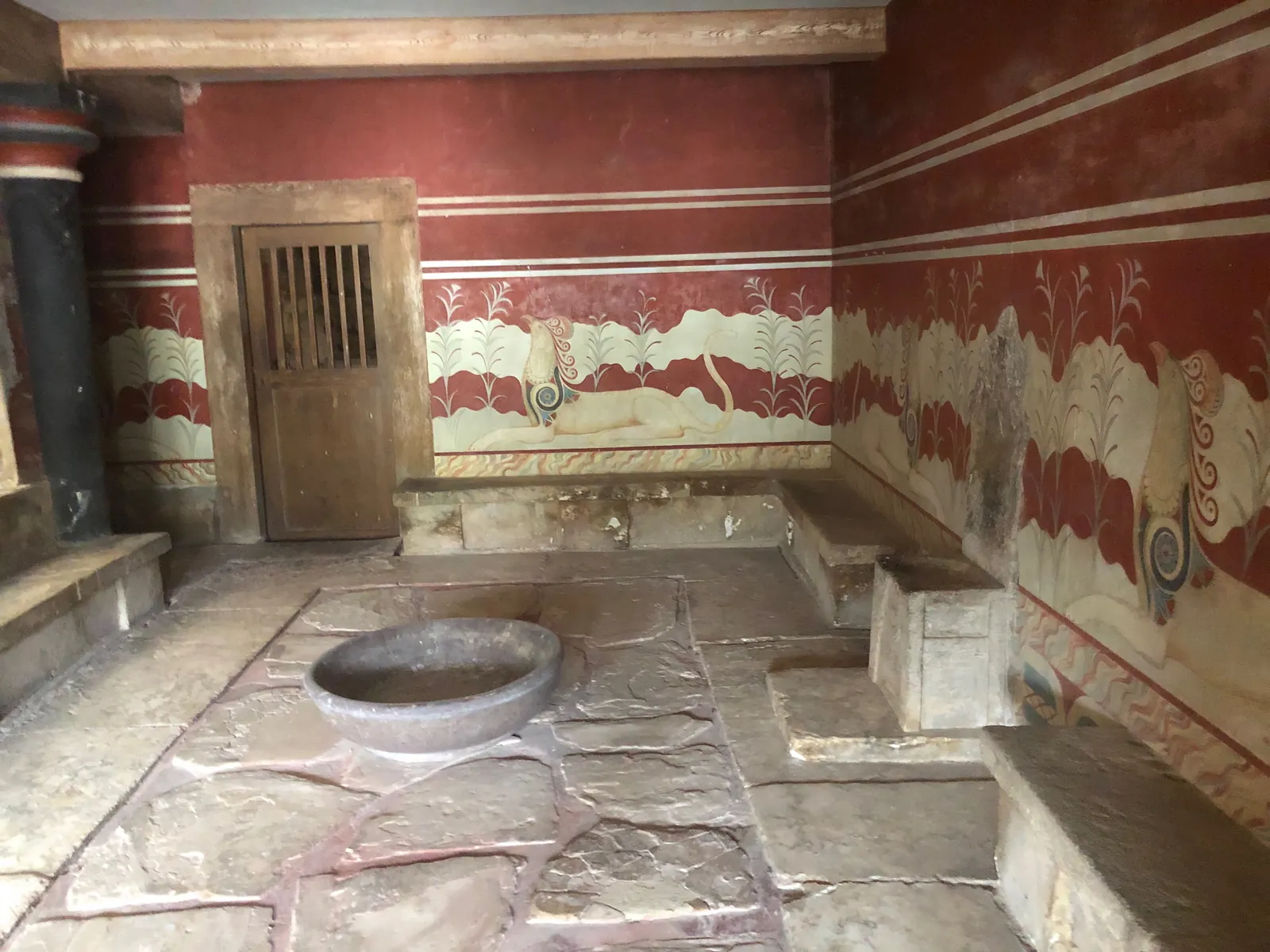
| On your own, prepared | The group wants a short highlights visit. Read this page first and look for the red columns, the throne room and the storage jars. |
The site is exposed, with some shade but not enough to rely on. The official page lists toilets, a café-restaurant, a shop, Wi-Fi and parking. Bring water, hats and sun protection, and wear shoes for uneven ground.
A baby carrier is generally easier than a pushchair on uneven archaeological ground. If you bring a pushchair, confirm the current accessible route and expect sections where it cannot go; carrying a small child in the heat is tiring, so plan shorter loops. Use the toilets near the entrance before you set off, and keep snacks for later. Give children four things to find: the bulls, the huge storage jars, the throne and the red columns.
Parts of the route can be explored on foot, but the site is exposed and uneven, and some famous spaces are seen from controlled paths rather than entered. The official “accessibility” label does not mean every area is step-free or visible from an accessible route. Contact the site before the day, through the official Hellenic Heritage page, and ask:
Published Hellenic Heritage information, rechecked 5 September 2026:
| Period | Published hours |
|---|---|
| 1 April–31 August | 08:00–20:00 |
| 1–15 September | 08:00–19:30 |
| 16–30 September | 08:00–19:00 |
| 1–15 October | 08:00–18:30 |
| 16–31 October | 08:00–18:00 |
| 1 November–31 March | 08:00–17:00 |
| Admission | Published price |
|---|---|
| Full | €20 |
| Reduced | €10 |
Last admission is published as 20 minutes before closing. The official page lists closure on 1 January, 25 March, 1 May, Easter Sunday and 25–26 December, and a set of free-admission dates. Book through the official ticket channel, and confirm eligibility, closures and hours on the current official page before you travel.
| Shape of the day | Best for | How it feels |
|---|---|---|
| Knossos alone | Groups for whom the site is the point but a museum afterwards would be too much | Visit early, allow time to understand the reconstruction and keep the return relaxed. |
| Knossos and the Heraklion Archaeological Museum | The strongest complete cultural day | Knossos gives you the architecture and the landscape; the museum holds many of the original Minoan objects and frescoes. Decide the order by season, tickets and energy. |
| Knossos, the museum, then the 1866 Street market and lunch | Groups with energy left who want to shop and eat in the city | Park once in the centre, walk to the museum, then to the market street around 1866 Street for your shopping, then lunch. A relaxed final stage, not another attraction. |
What does not work is Knossos, the museum, an aquarium, a water park and a long city checklist in one day. That is not comprehensive; it is exhausting.
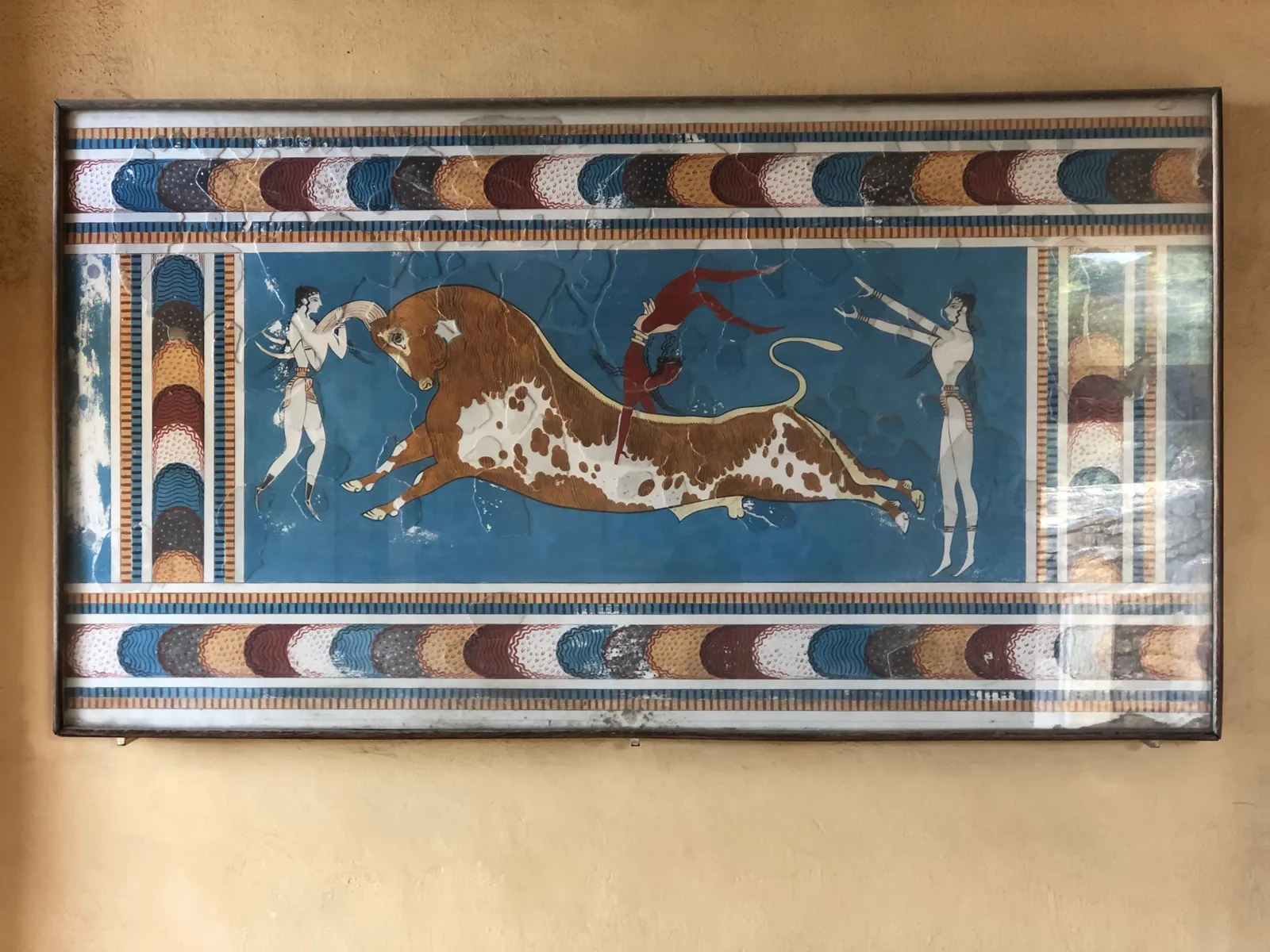
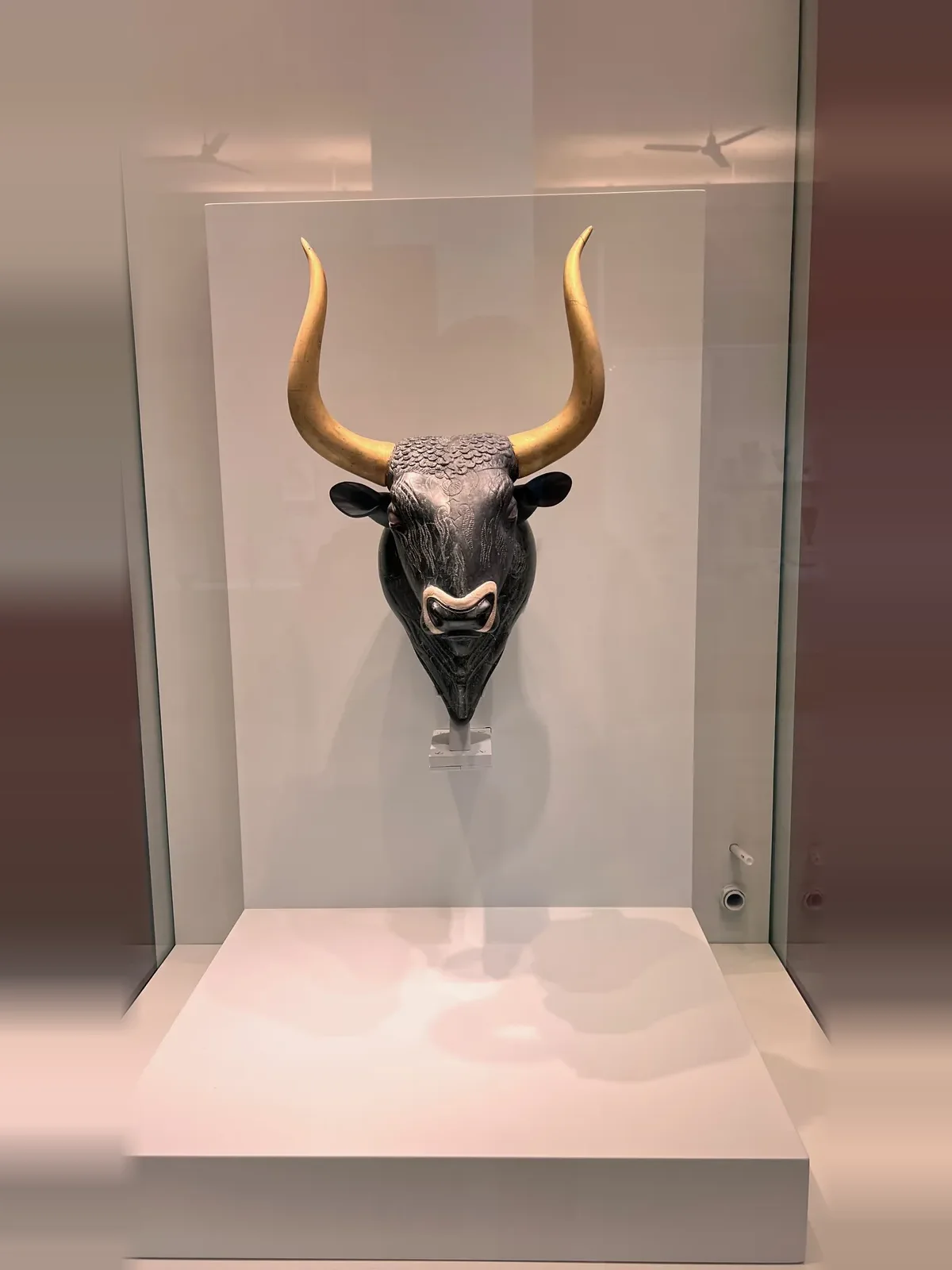
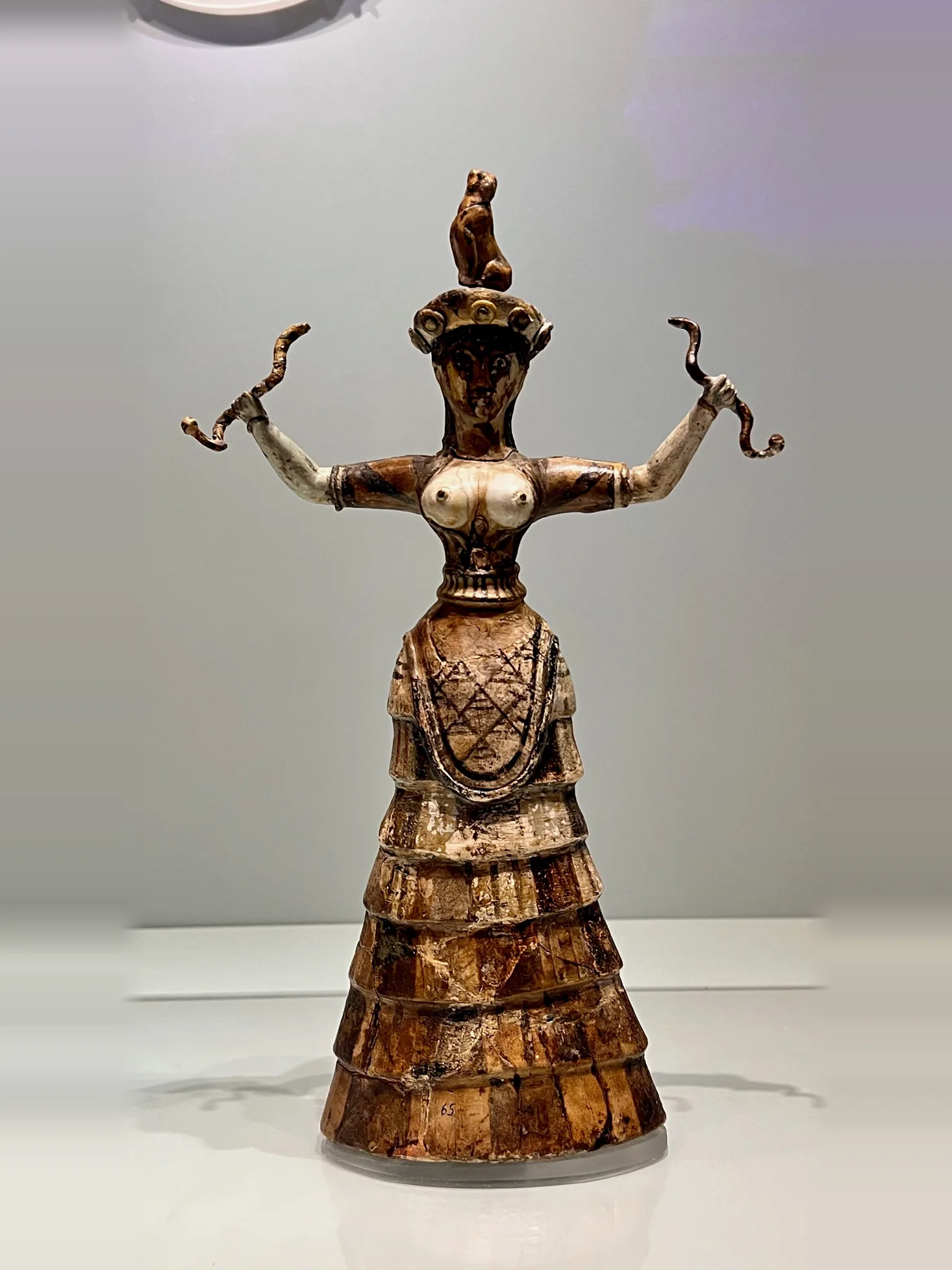
The Heraklion Archaeological Museum has the original fresco fragments and the museum’s reconstructions of them, including the bull-leaping fresco whose copy you see at Knossos. It also holds major Minoan objects such as the bull’s-head rhyton from Knossos and the Phaistos Disc, found at Phaistos, across 27 galleries.
It’s a separate institution, with its own ticket (€20 full, €12 reduced) and its own hours. From April to October it is published as open 08:00–20:00, except on Wednesday, when it opens at 13:00. From November to March it is 08:30–15:30, opening at 10:00 on Wednesday. Last admission is 20 minutes before closing (checked 21 September 2026). The official page lists a lift and accessibility services.
Allow at least 1½ hours; see our Heraklion Archaeological Museum Guide for the highlights and a route.
| Knossos first when | Museum first can work when |
|---|---|
| The weather is warm; the site is best near opening | The weather is cool |
| The group tires easily | The museum is open early that day |
| It is a Wednesday and the museum opens at 13:00 | You want to see the originals before the site |
From the villas, our default in warm weather is Knossos near opening, then the museum.
Knossos is about 5 km from the museum, 15–20 minutes by car depending on traffic. Park once, in one of the car parks a short walk from the museum, and leave the car there for the rest of the visit. Don’t move it between stops in the city.
After the museum, the traditional market street around 1866 Street is a few minutes on foot: good for local products, herbs, cheese and gifts. Each shop keeps its own hours, and it’s quieter on Sundays and later in the day. Then sit down for lunch in the centre before the drive home.
Knossos is the reason for the day, but it does not have to be the only thing in it. Treat these as alternatives, not additions. After Knossos, choose one: the archaeological museum and central Heraklion, lunch in Archanes, or a swim at Bali on the way home. Do not try to combine them.
| Second stop | What it is | Best for |
|---|---|---|
| Archanes | A restored wine village about 7 km south of Knossos, below Mount Giouchtas: tavernas in the square, local wine, Minoan remains of its own, and wineries in the surrounding vineyards. Ask Argyris for a suggestion or choose one yourself, and book the tasting ahead. | A long, quiet lunch instead of the city; couples and wine lovers. With a winery visit, do not drive: ask Argyris and he can suggest a transfer company. |
| A swim on the way home | Bali, a small resort built around coves just off the national road, on the way back west towards the villas. | Hot days and families: the sea after the site is the reward children remember. |
With children, Knossos plus a swim is usually a better day than Knossos plus a museum. With a wine lover in the group, Archanes wins. And if the group has energy for only one thing, Knossos alone is still a good day.
| Decision | When it is the right one |
|---|---|
| Choose Knossos | Someone in the group really cares about Minoan Crete, archaeology or mythology, and everyone accepts an early start. |
| Start with Ancient Eleutherna instead | You want a closer, calmer, museum-led day. Eleutherna is not a substitute for Knossos — it tells the later chapters — but it may be the better decision for the holiday you actually want. |
| Postpone Knossos | Heat, limited mobility, a late arrival the night before or very young children would make the drive and the exposed site more demanding than rewarding. Fame does not create an obligation. |
| Group | How Knossos usually works |
|---|---|
| Archaeology and mythology | The reason to make the journey; add the museum and it becomes the most important cultural day of the holiday. |
| Families with children | Works well when the myths come first and the explanations stay concrete. Arrive before the heat, and resist adding unrelated attractions: a child-friendly day is not automatically a longer one. |
| Older guests | Parts of the visitor route can be explored on foot, but the site is exposed and includes uneven surfaces; confirm the right route for anyone with limited mobility. The museum can be the main event, with Knossos kept short. |
| Short stays | On a week or less, weigh the long day honestly against a calmer heritage visit nearer the villas, such as Arkadi or Ancient Eleutherna. |
Early, and on a day with nothing else fixed. The current official schedule lists opening at 08:00 throughout the year; recheck before travelling. In July and August, aim to enter close to opening. Spring and autumn are kinder than July and August, when the open site is genuinely hard work by late morning. Check the closure dates before you choose the day, and remember the Heraklion museum keeps its own timetable.
Knossos is approximately 72 km from Asteri Village and 70 km from Stavromenos — about 75 to 90 minutes each way, east on the national road towards Heraklion. That is the reason this is a deliberate day rather than an extra. The time depends on the villa you start from, the traffic around Heraklion and the season, so use live navigation on the morning.
For groups across MAZI — Villa Asteri, Villa Kitron and Villa Myrrini — agree three things before anyone leaves: the meeting point, the ticket plan and whether the museum is part of the day. Leave the return open. Even when the group finishes with lunch in Heraklion, keep the evening at the villa simple: a swim, a barbecue, no reservations.
For Knossos the difference is small. Stavromenos and Villa Argiris sit right by the national road east, which saves a few minutes each way. From Asteri Village you drop down to the same road in a few minutes. Choose the villa for the rest of the holiday, not for this one day — compare the villas if the choice is still open.

If Knossos is important to you, make it the reason for the day and leave early. Add the archaeological museum for the strongest cultural context. If the group still has time and energy, finish with food and shopping in central Heraklion, using one of the private car parks there and continuing on foot. If nobody is especially interested in Knossos, Eleutherna may give you a calmer and more rewarding cultural day closer to the villas.
Argyris Skordilis · Owner and host, Amazing Villas in Crete · usually replies within 12 hours
Sources: Hellenic Heritage: Knossos visitor information; UNESCO World Heritage Centre: Minoan Palatial Centres; UNESCO decision 47 COM 8B.25; Hellenic Heritage: Heraklion Archaeological Museum; Visit Heraklion (Region of Crete): Archanes; Hellenic Heritage Tickets: Knossos; Hellenic Heritage: Digital Guide. Figures are approximate. Hours, seasonal closing times, the €20 and €10 admissions, last admission and closure dates were taken from the official Hellenic Heritage page and rechecked on 5 September 2026. The 2025 inscription follows the UNESCO World Heritage Centre and its decision record; Knossos is described as one of six components, not as a site inscribed alone. The site area and the Evans reconstruction context follow the official page. The Heraklion Archaeological Museum’s hours, Wednesday opening, prices and facilities were taken from its official Hellenic Heritage page on 21 September 2026. Parking at Knossos and in central Heraklion follows the owner’s local knowledge; charges are not quoted. The 1½–2-hour site estimate is our planning figure, not an official one. The Archanes distance follows Visit Heraklion. Distances were measured on a road-routing map in September 2026 and rounded. Hours, prices, ticket rules and access change, so confirm them before you travel.
Facts checked against our four villa pages · Last reviewed by Argyris Skordilis, owner of Amazing Villas in Crete.
Yes, when Minoan archaeology or mythology is a priority for someone in the group. It is less convincing as a box to tick. The day works best with an early start and one well-chosen second stop.
They tell different chapters. Knossos is the Minoan palace world and the famous name; Eleutherna, about 20 minutes from the villas, is strongest on the centuries after the palaces and makes a calmer museum-led day. If only one fits, choose by interest and energy, not by fame.
It can be, especially when the myths give them a way into the archaeology. Keep explanations concrete, arrive before heat and tiredness build, and do not add several unrelated attractions. A child-friendly day is not automatically a longer one. A baby carrier is generally easier than a pushchair on the uneven ground.
About 1½–2 hours for the archaeological site itself; a highlights visit can be shorter and a guided one longer. With the drive, parking and entry, it fills a full morning. Adding the Heraklion Archaeological Museum turns it into a full cultural day.
It is sensible in high season. Use the official Hellenic Heritage ticket platform, not a look-alike reseller, and check the date, admission conditions and any entry window shown during checkout, as ticket rules can change.
Yes, right beside the site entrance, from our own local experience. Availability and any charges can change, so we do not quote them; arriving near opening makes it easier in summer.
Not necessarily, but context matters here more than at most sites. A licensed guide suits groups for whom archaeology is the point; a digital guide or good preparation suits a shorter, self-paced visit.
When rechecked on 5 September 2026, the official Hellenic Heritage page listed full admission at €20 and reduced at €10, with daily hours from 08:00 and closing between 17:00 and 20:00 by season. Last admission is 20 minutes before closing. Recheck the schedule, closures and eligibility before you travel.
The official page lists accessibility among its amenities, but that does not mean every ancient area is step-free or equally visible. Confirm the current accessible route and the facilities you need directly, for the person travelling.
No. They belong to the 20th-century restoration and reconstruction associated with Arthur Evans, based on his interpretation of the site. Ancient remains and modern interventions sit side by side at Knossos; telling them apart is part of the visit.
Yes. In 2025 it was inscribed as one component of the serial World Heritage property Minoan Palatial Centres, together with five other sites in Crete: Phaistos, Malia, Zakros, Zominthos and Kydonia.
Yes, for the strongest archaeological context: it holds original fresco fragments and museum reconstructions, the bull’s-head rhyton from Knossos and the Phaistos Disc. It has its own ticket (€20 full, €12 reduced) and timetable, and opens later on Wednesdays (13:00 from April to October).
In warm weather, Knossos first, near opening, and the museum afterwards. Also check the day: the museum opens later on Wednesdays.
Choose one alternative, not all: the archaeological museum and central Heraklion, lunch in Archanes (a wine village about 7 km south of Knossos, with wineries around it), or a swim at Bali on the way home. If Archanes includes a winery visit, a private transfer with a driver is the better way to do the day.
Tell Argyris whether Knossos is a priority or simply a possibility. He can help you choose between the long east-bound day and a calmer heritage visit closer to the villas.
Cookies on this site
We use essential cookies to make the site work. With your permission we also use statistics to improve the site, marketing cookies to measure our advertising, and external media such as Google Maps. You can change your choice at any time. Privacy Policy · Cookie Policy