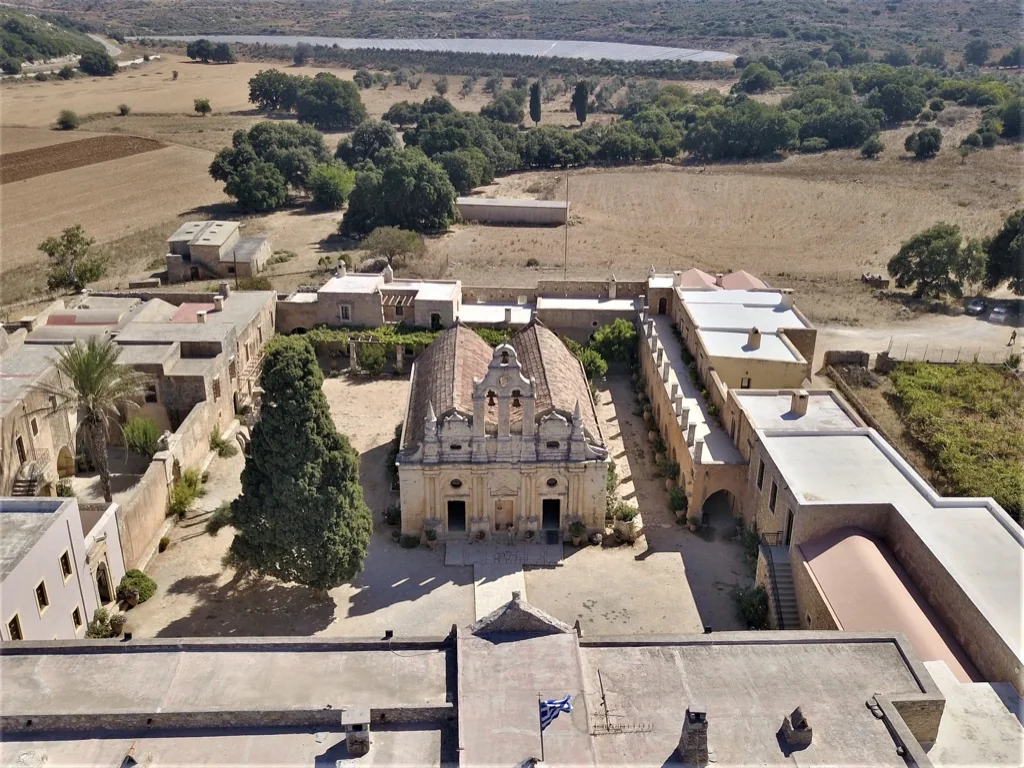
Arkadi is beautiful, but beauty is not the reason to come.
The Renaissance façade, the enclosed courtyard and the mountain setting draw the eye first. Then the powder magazine, the ossuary and the museum change the visit. Arkadi is a living Orthodox monastery, a place of pilgrimage and one of the defining sites of the Cretan struggle of 1866. It deserves quiet attention rather than a quick photograph between other stops.

By Argyris Skordilis, owner and host · Updated
Arkadi is not an abandoned monument. The monastery’s own visitor information describes a functioning Orthodox community and a place of pilgrimage: services, monastic life and private areas continue alongside the visitors.
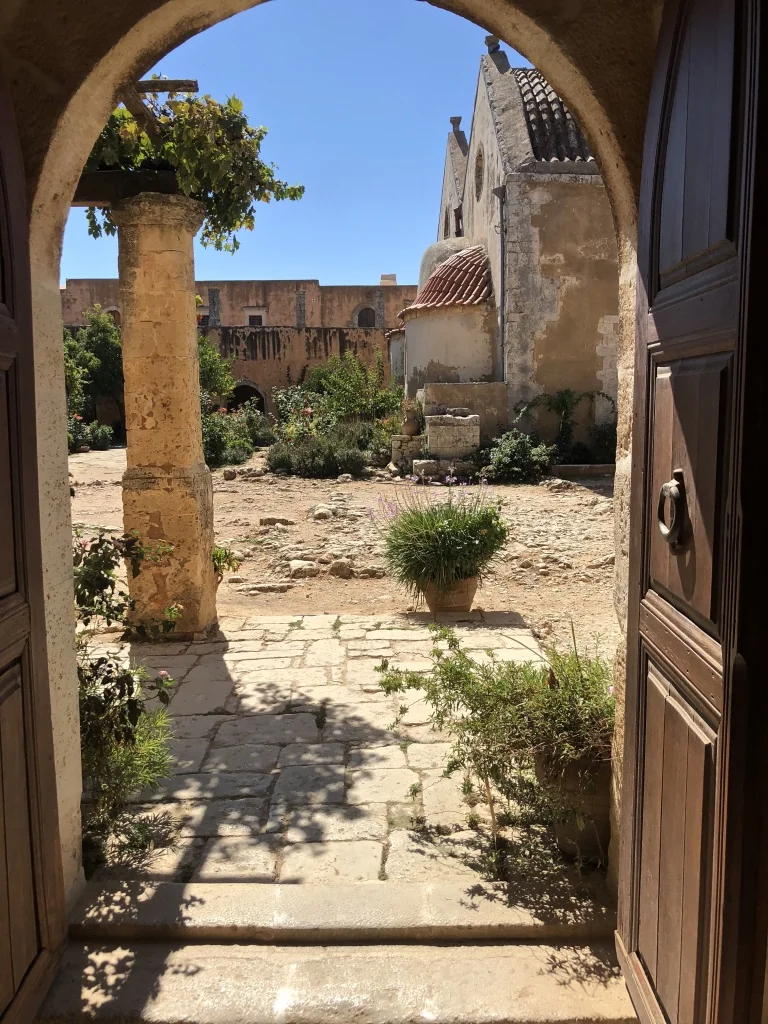
That changes what good behaviour looks like. Speak quietly, keep doorways and worship spaces clear, follow the clothing guidance at the entrance, and do not photograph anyone at prayer without asking. On Sundays the museum opens after the Divine Liturgy: the visiting timetable follows the life of the monastery, not the other way round.
What to wear: shoulders and knees covered for everyone. Nobody will be unkind about it, but you will feel it if you arrive in a swimsuit and a sarong on the way back from the beach.
The double-aisled central church was built in 1587 and is dedicated to the Transfiguration of Christ and to Saints Constantine and Helen. Its façade carries Renaissance influence and gives Arkadi an architectural identity unlike a simple rural chapel.
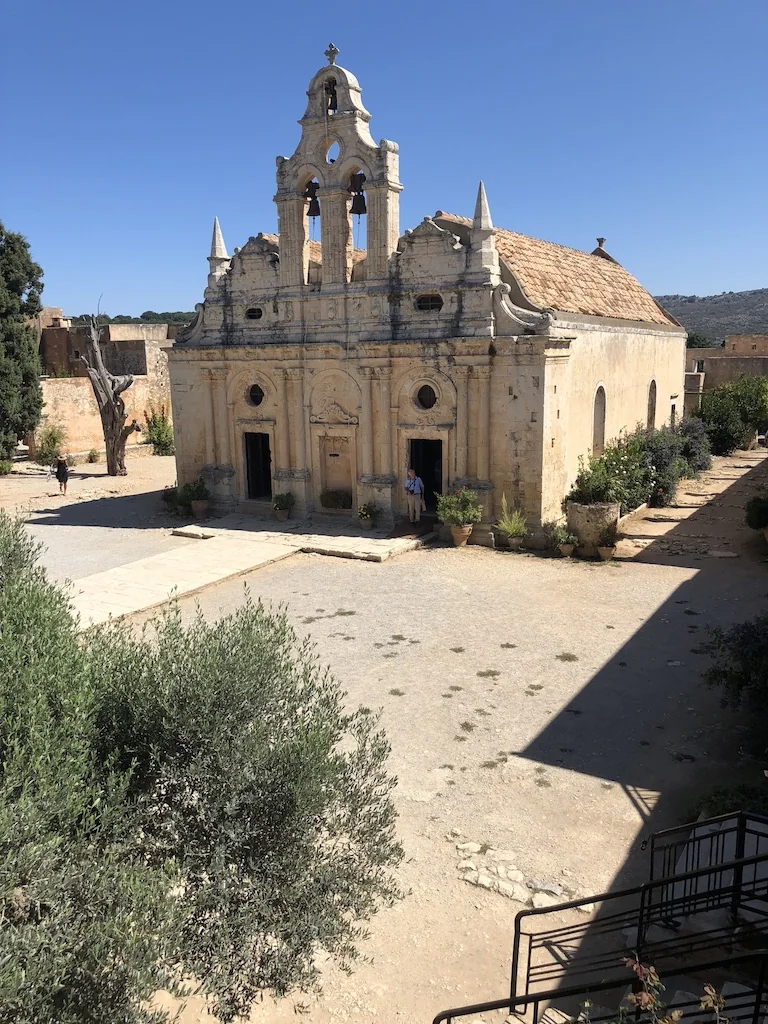
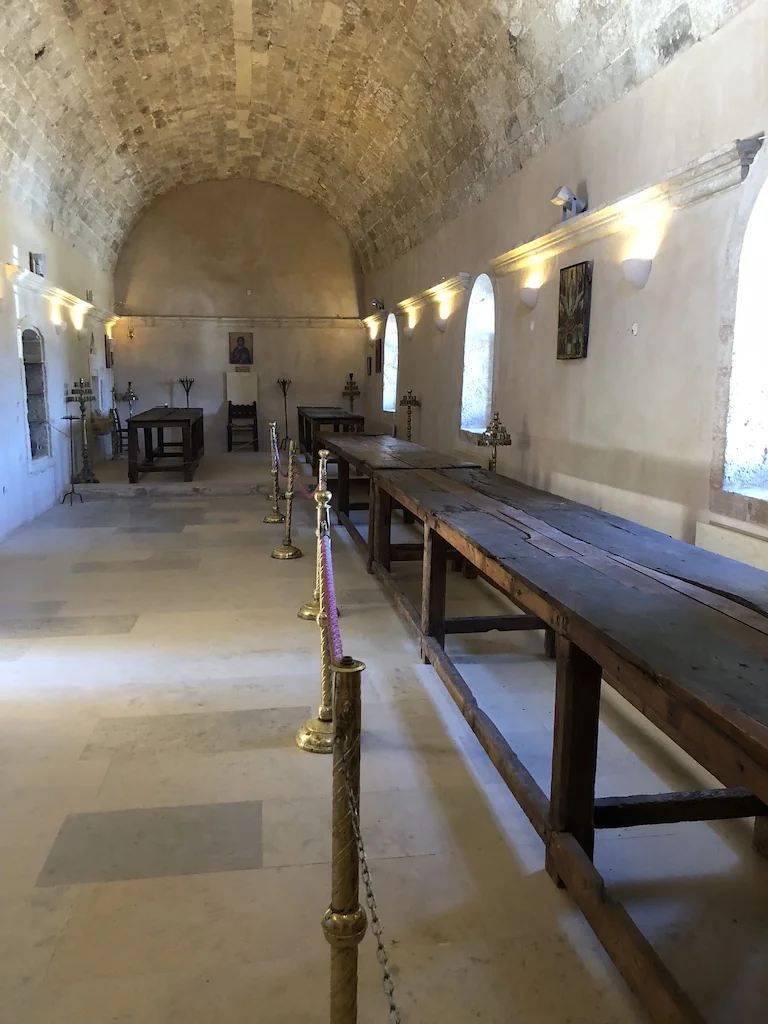
Around it, the fortified complex preserves layers of work, worship and hospitality: the historic dining room, the cellars, the gates, the monks’ cells, the museum and the gallery. The official history places the foundation around the 11th century while acknowledging that the exact date is uncertain. By the 17th century the monastery was known for copying manuscripts; in the 18th, for gold embroidery.
Do not hurry straight to the powder magazine. The church and the working rooms explain what Arkadi was before 1866, and why it mattered enough to become a centre of resistance.
During the Cretan revolt against Ottoman rule, fighters and civilians took refuge inside the monastery. The official account records 964 people enclosed within the complex during the siege in November 1866. When Ottoman forces broke through, the powder magazine exploded, killing many of those inside and around it.
The event became an international symbol of sacrifice and resistance, and it is best met quietly: not as spectacle, not as simplified legend, and not as a backdrop for photographs. The powder magazine, the ossuary and the museum carry the human consequences of that siege.
With children, explain the outline before you go in: people sheltered here, they were besieged, and many died. Adapt the detail to the child — but do not let the place become “the room that blew up”.
You do not need to photograph every room. A slower circuit makes the relationship between daily monastic life and national memory much clearer.
Published information, rechecked 5 September 2026:
| Period | Published hours |
|---|---|
| March | 09:00–18:00 |
| April–May | 09:00–19:00 |
| June–August | 09:00–20:00 |
| September | 09:00–19:00 |
| October | 09:00–18:00 |
| November | 09:00–17:00 |
Admission: €4 general, free for young people up to 16 (rechecked 5 September 2026). The official page does not publish December to February hours in the same list, and we will not infer them — ask the monastery if you are travelling in winter. On Sundays the museum opens after the Divine Liturgy.
| At the monastery | What we know |
|---|---|
| Tickets | Bought at the entrance; no booking needed |
| Card or cash | Cards are accepted |
| Parking | Outside the complex, a short walk from the gate; there is room for a minivan |
| Toilets, water, shade | Toilets and water on site; the courtyard is open and hot in July and August |
| What to wear | Shoulders and knees covered; shoes for uneven stone |
Arkadi has old thresholds, stone surfaces and rooms built for monastic use rather than modern visitor circulation. Do not assume the complex is step-free or wheelchair accessible. Anyone with a specific mobility need should ask the monastery about the current visitor route and the particular spaces they hope to enter.
Summer heat makes the open courtyard tiring, especially as part of a longer multi-stop day. Shade, water and an unhurried pace matter here more than at most sites. Religious celebrations and commemorations can also change the experience substantially — which is sometimes the reason to go, and sometimes the reason to choose another day.
| Route | Best for | How the day feels |
|---|---|---|
| Arkadi on its own | Families with younger children, grandparents, short stays, anyone who wants one focused heritage visit | Allow 60–90 minutes, then home for the pool, a rest or an early barbecue. |
| Arkadi and Ancient Eleutherna with its museum | Families with older children, history lovers, a substantial but focused heritage day | Arkadi gives you living religious memory and 1866; Eleutherna opens Crete’s much longer archaeological story. |
| Arkadi, Ancient Eleutherna with its museum, and Margarites | Culture travellers, craft lovers, guests staying long enough for a full inland day | Monastery, archaeology, then pottery. Start early and keep Margarites as the relaxed final stage. |
When to keep it simple. Choose Arkadi alone, or Arkadi and Eleutherna only, when the day is very hot, the group includes very young children or tired older guests, or last night ended late. If the group does not enjoy museums, keep Arkadi as the single visit. And do not add a south-coast beach to the end of a heritage day just to fill it: a shorter outing and an afternoon at the villa is often the better holiday.
| Group | How Arkadi usually works |
|---|---|
| History and architecture | The reason most guests come, and the visit rewards an hour and a half rather than forty minutes. |
| Families | Works from about primary-school age, with the story explained beforehand; the courtyard gives children room while adults read. |
| Older guests | The distances are short, but the surfaces are old stone; go early, sit in the shade, and skip anything that needs a step you would rather not take. |
| Guests of faith | A living monastery and a place of pilgrimage; services are part of the day, not an interruption to it. |
It suits less well a group looking for something to do in an hour between beaches. Arkadi asks for a little more than that.
Early. The gates open at nine, the light is good on the façade, the courtyard is still cool and the coaches have not arrived. In July and August that is not a preference but the difference between a good visit and a hot one. Sundays are different — the museum opens after the liturgy — and around the commemoration in November the monastery is a different place again: fuller, more solemn, and worth knowing about before you arrive.
Arkadi is approximately 9 km from Asteri Village and 11 km from Stavromenos, about 15–20 minutes by car on a road that climbs steadily. Use live navigation from your own villa and check the current opening information on the day.
For guests staying across MAZI — Villa Asteri, Villa Kitron and Villa Myrrini — keep the plan simple: one departure time, one meeting point, one realistic return window. Not everyone needs the same programme. Some will want Arkadi only, some will continue to Eleutherna, some will add Margarites and some will stay by the pool. What does not work is a group of three cars arriving separately and organising itself in the monastery car park.
Arkadi is the closest heritage site to all four villas, so this is a small difference rather than a decisive one. From Asteri Village — Villa Asteri, Villa Kitron and Villa Myrrini — you are already on the inland side, and the climb starts almost immediately. From Stavromenos, Villa Argiris adds a couple of kilometres and gives you the sea to come back to. Compare the villas if the choice is still open.

Give Arkadi its own quiet time. The façade is memorable, but the visit only makes sense when you also go into the museum and stand for a moment at the powder magazine. If the group is tired afterwards, emotionally or physically, continue to one place — not three.
Argyris Skordilis · Owner and host, Amazing Villas in Crete · usually replies within 12 hours
Sources: Sacred Monastery of Arkadi: visitor information; Sacred Monastery of Arkadi: history; Sacred Monastery of Arkadi: museum; Visit Greece: Arkadi Monastery. Figures are approximate. Hours, admission and the Sunday museum timing were taken from the monastery’s own information and Visit Greece and rechecked on 5 September 2026; December to February hours are not published and are not inferred here. The 964 people enclosed during the siege follow the monastery’s official account. Distances were measured on a road-routing map in September 2026. Services, commemorations, hours and admission change, so confirm them before you travel.
Facts checked against our four villa pages · Last reviewed by Argyris Skordilis, owner of Amazing Villas in Crete.
Yes, particularly if you are interested in Cretan history, religious heritage or architecture. It is one of the island’s defining places of memory and remains a working monastery rather than simply a historic attraction.
Allow roughly 60–90 minutes for the church, the museum, the powder magazine, the ossuary and the historic rooms without rushing. Add time if a service, a commemoration or your own interest changes the pace.
Fighters and civilians took refuge in the monastery during the Cretan revolt against Ottoman rule; the official account records 964 people enclosed during the siege in November 1866. After the siege the powder magazine exploded as Ottoman forces entered. Many people died, and the event became an international symbol of Cretan resistance and sacrifice.
Yes. Orthodox worship and monastic life continue, and services can affect access and museum timing. Cover shoulders and knees, keep voices low, and ask before photographing anyone at prayer.
When rechecked on 5 September 2026, admission was €4 with free entry for young people up to 16. Published hours open at 09:00 and close between 17:00 and 20:00 depending on the month, from March through November; December to February hours are not published in the same official list, so ask the monastery if you are travelling in winter. On Sundays the museum opens after the Divine Liturgy.
Do not assume the historic complex is step-free. There are old thresholds and uneven stone surfaces. Anyone with a specific mobility requirement should confirm the current route and the accessibility of the church, museum and powder magazine directly with the monastery.
Yes. Arkadi and Ancient Eleutherna make a substantial heritage day; Margarites can be a gentler third stage for pottery and a village walk. Keep the third stop optional, and drop it when the group is hot or tired.
From about primary-school age, yes, if you explain beforehand what happened here. The courtyard gives children space while adults read, but the story of the siege needs a sentence or two of preparation rather than a surprise at the ossuary.
Would your group value Arkadi as a focused heritage visit, or as the beginning of a longer inland day? Tell Argyris your dates and who is travelling, and he will tell you which version suits your stay.
Cookies on this site
We use essential cookies to make the site work. With your permission we also use statistics to improve the site, marketing cookies to measure our advertising, and external media such as Google Maps. You can change your choice at any time. Privacy Policy · Cookie Policy